We would like to count page views and clicks with Google Analytics, which sets cookies in your
browser. It is how we learn which pages are worth writing. Nothing loads until you choose, and
declining costs you nothing on this site. What we collect.
Ultimate ownerStartpage B.V. (System1 minority stake)Netherlands · Nine Eyes
Operates StartpageStartpage B.V.
StartMail
Sibling brands share the same ultimate owner as Startpage.
Dutch. In 2019 System1, a US advertising technology company, took a significant stake, which caused several privacy communities to drop their recommendation at the time. Startpage says search operations remain independent and under Dutch law. This is exactly the kind of ownership fact this site exists to put in front of readers rather than leave to a forum thread.
Public-source facts, not yet checked against primary documents. How we verify.
Lab test pending: score uses public, checkable data only. How we verify.
Verdict
Startpage does something no other private search engine does: it serves Google's results with the tracking stripped out, and its Anonymous View opens any result through a proxy so the destination site never sees you either. The product is genuinely good and Dutch data protection law sits behind it. The material fact is the ownership. In 2019 System1, a United States advertising technology company, took a significant stake, and several privacy communities withdrew their recommendation on the spot. Nothing has since been found to show the search operation was compromised. The conflict of incentives is structural and it has not gone away.
Best for
People who want Google's result quality without Google's profile, and who will use the proxy view to open results without being tracked by the destination.
Not for
Anyone who treats an advertising company holding a stake in a privacy product as disqualifying, or who wants an engine with its own index.
Free, funded by contextual advertising on search results.
What it does, feature by feature
Feature
Startpage
Platforms
iOS, Android, Browser
Own index ⓘ
✗
No user tracking
✓
No advertising
✗
No IP logging
✓
Anonymous result view ⓘ
✓
Open source
✗
Browser extension
✓
AI features optional ⓘ
✓
Customisable ranking
✗
A question mark means we have not confirmed the feature, not that it is missing. Hover a feature name for what it means.
The product first
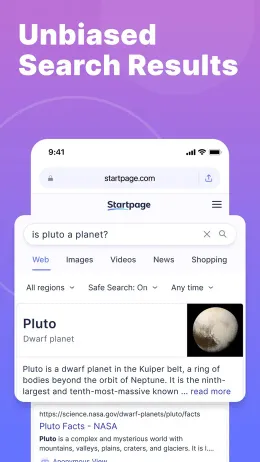
Startpage buys Google’s results and shows them to you with everything identifying stripped out. Your IP address is not passed on, no cookies follow you, no profile is built, and Google receives a query without a searcher attached to it. For anyone who has tried a privacy engine and quietly gone back to Google because the results were not good enough, this solves the exact problem, and it is the only mainstream option that does.
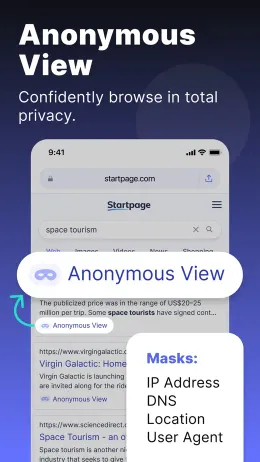
Anonymous View goes a step further than any rival in the private search category. Next to each result is an option to open the page through Startpage’s proxy, so the destination site sees Startpage’s servers rather than your browser and your address. It is slower, it breaks anything interactive, and it puts Startpage in the middle of the connection rather than removing the middle entirely. Used for what it is good for, reading a page without leaving a trace on it, it is excellent.
The company also runs StartMail, a paid email service, which is a sibling brand rather than a separate company.
Where the results come from, and who pays
Component
Source
Who is paid, and how
Web results
Google, under a paid commercial arrangement
Startpage pays Google for the results feed
Anonymous View
Startpage’s own proxy servers
Funded from search advertising revenue
Advertising
Contextual ads matched to the query only
Advertisers, through a search advertising partnership
Company funding
Dutch operating company, minority stake held by System1
An advertising technology firm holds equity
StartMail
Separate paid subscription
Direct subscriber revenue
The last two rows are why this review is not a straightforward recommendation.
The ownership question
In 2019, System1, a United States advertising technology company, acquired a significant stake in the Startpage group. It was not announced in a way that reached most users, and privacy communities found out and reacted. Several long-standing recommendation lists dropped Startpage.
The reasoning was not that anything had been caught happening. It was that a company whose business is building advertising audiences had acquired a meaningful interest in a company whose entire product is refusing to build one, and that this is a conflict you cannot audit away. Startpage’s answer was that search operations remain separate, remain in the Netherlands and remain governed by Dutch and EU data protection law, and that no user data flows to the shareholder.
As far as we can establish, nothing has emerged since to contradict that. We are not repeating an accusation, because there is not one. We are recording an ownership fact that changes how a careful reader weighs the product, which is the entire purpose of our ownership explorer. A privacy tool asks for trust, and who holds the equity is part of what you are trusting.
The comparison worth making is with Incogni, owned by Nord Security, or with the Kape group behind ExpressVPN and Private Internet Access. None of these are secrets. All of them are things buyers routinely do not know, and all of them are decided in a boardroom rather than in a privacy policy.
The dependency nobody can fix
Startpage has no index. Every result you see is Google’s, bought under a commercial agreement. That is a business risk rather than a privacy risk, and it is a serious one: the product exists at the discretion of the company it was built to protect you from. The same structural point applies to DuckDuckGo with Bing. Only a handful of engines in the category crawl the web themselves.
Closed source is the other gap. Nothing about the no-logging claim can be verified from outside, and no independent audit of Startpage’s data handling has been published. That is common in this category and it is still a gap.
Who should use it
Someone who wants Google’s result quality, will not accept Google’s profile, and is comfortable weighing a minority adtech shareholder against a Dutch operating company and EU law. That is a reasonable position to reach. So is the opposite one. What is not reasonable is reaching either without knowing the shareholding exists, which is how most people arrive at Startpage.
What we have not tested
We have not run a controlled result quality comparison between Startpage and Google, so our statement that the results are Google’s reflects the company’s published arrangement rather than a test we performed. We have not measured Anonymous View’s proxy latency, nor audited what that proxy logs, and neither can be established from outside. We have not verified the current size or terms of the System1 shareholding beyond the 2019 reporting and Startpage’s own statements, and our provider record flags it as needing a primary source check. No independent audit of the no-logging claim exists for us to cite.
Startpage against the top two private search engines
The System1 stake is documented in 2019 reporting and Startpage own statements; confirm the current shareholding before restating it.
Frequently asked questions
Who owns Startpage?
Startpage B.V., a Dutch company operating since 2006, with a significant minority stake held by System1, a United States advertising technology firm, acquired in 2019. The operating entity and the search operation remain Dutch and under Dutch law by the company's own account. Our provider record lists the ultimate owner as Startpage B.V. with the System1 stake noted, and our ownership explorer exists precisely to put facts like this in front of readers rather than leave them in a forum thread.
What happened with System1 in 2019?
System1 acquired a significant stake in the Startpage group. The news surfaced in the privacy community rather than through a prominent announcement, and several well known privacy recommendation lists removed Startpage at the time, reasoning that an advertising technology company's incentives are the opposite of a privacy product's. Startpage responded that search operations continued independently under Dutch law and that no user data was shared. No evidence has emerged contradicting that. The objection is about incentives and control, not about a demonstrated failure.
Does Startpage use Google?
Yes. It pays Google for results and serves them to you without passing on your IP address, cookies or an identity, so the ranking quality you get is Google's while the profiling is not. It has no index of its own, which makes the supplier relationship the single biggest dependency in the product. If the terms of that relationship changed, so would the service.
What is Anonymous View?
A proxy that opens a search result through Startpage's own servers, so the website you clicked sees Startpage rather than you. It is the feature that most distinguishes Startpage from DuckDuckGo, and it is genuinely useful for reading a page you would rather not be logged visiting. It is slower than a direct visit, breaks interactive sites and logins, and it is not a substitute for a VPN or Tor, because Startpage itself is in the middle of the connection.
Is the Netherlands a good jurisdiction for a search engine?
Dutch and EU data protection law is among the stronger frameworks in the world and gives a privacy product real legal footing, which is better than the United States offers. The Netherlands is also a member of the Nine Eyes intelligence alliance, so it is not outside intelligence sharing arrangements. For a service that says it retains no IP addresses and builds no profile, the practical exposure to either is limited by how little there is to hand over.
Should I use Startpage or DuckDuckGo?
If result quality on difficult queries matters most, Startpage wins, because Google's index is better than Bing's. If ownership matters most, DuckDuckGo wins, because it is fully independent with no advertising company on the share register. Both are free, both show contextual advertising, and neither has its own index. There is no answer that is correct for everyone, which is why our ranking lists one as a pick and the other under a caveat.